
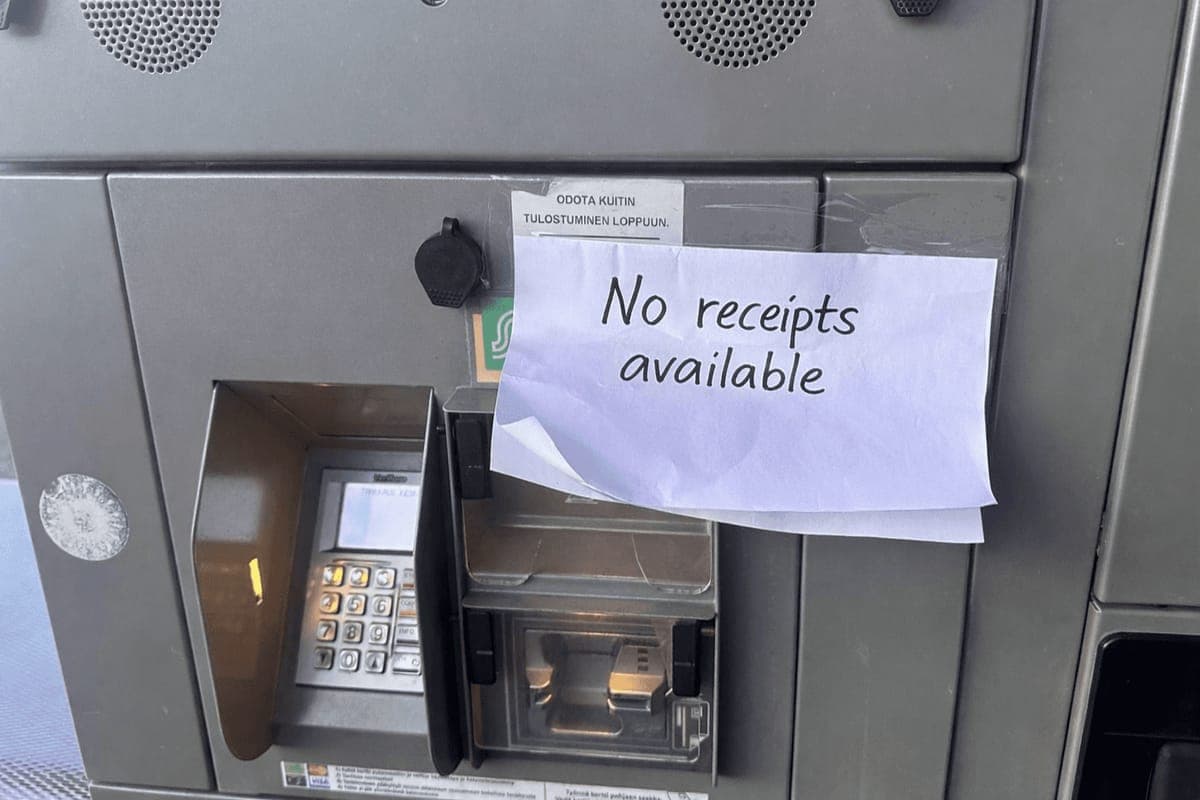

Unmanned fuel stations are built for efficiency. No staff on site, automated payments, minimal operational overhead. But there is one small component that still carries outsized business impact, the receipt.
When a station cannot reliably issue receipts, whether due to printer failure, empty paper rolls, or hardware limitations, the consequences extend far beyond a minor inconvenience. For unattended fuel sites, missing receipts create measurable financial, operational, and reputational risk.
Receipts Are Mission Critical for Business and Fleet Customers
For private drivers, a missing receipt is annoying. For business and fleet customers, it is a blocker.
Fuel receipts are required for VAT reclaim, corporate expense reporting, and internal controls. Drivers need proof of purchase. Finance teams need structured documentation. When receipts are unavailable, the transaction may be complete technically, but not commercially.
At unmanned stations, there is no staff member to explain, reprint, or offer an alternative. The customer experience ends with a sign on the terminal and no clear next step.
No Staff Means No Recovery Moment
In staffed stations, receipt issues are visible and recoverable. At unmanned stations, they are silent.
When receipts fail:
- Customers leave without proof of purchase
- Support teams receive calls and emails later
- Disputes and chargebacks become more likely
- Business customers quietly stop returning
There is no opportunity to resolve the issue at the pump, and no easy way to win the customer back once trust is lost.
A Conservative Look at the Revenue Impact
Let’s look at a realistic, conservative scenario for an unmanned fuel station.
- Average transactions per day: 300
- Percentage of business or fleet transactions: 20 percent
- Average spend per business transaction: €80
That results in:
- 60 business transactions per day
- €4,800 in daily business revenue
- ~€1.75 million in annual business revenue
Now assume something very modest:
Due to unreliable receipt availability, 5 percent of business customers stop using the station
That is just 3 customers per day.
The impact:
- Daily revenue loss: ~€240
- Annual revenue loss: ~€87,600
This does not include the secondary effects of lost fleet accounts, higher support costs, or increased dispute rates.
Fleet Customers Amplify the Risk
Business customers are not interchangeable.
Fleet drivers often refuel multiple times per week and follow predefined station lists. When a station cannot provide compliant receipts, it is often removed from preferred routes entirely.
Losing just one small fleet account can mean:
- Multiple vehicles
- Repeat weekly refueling
- Predictable, long term volume
At unmanned stations, there is no on site interaction to reverse that decision.
Receipts Also Protect Revenue Already Earned
Receipts are not only for customers. They are critical evidence for merchants.
When customers cannot easily retrieve proof of purchase, disputes take longer, chargebacks become harder to resolve, and support teams spend time on cases that should never exist. Even small increases in dispute ratios can have a disproportionate financial impact once fees and manual handling are considered.
Case Study: How Neste Solved Receipt Availability for Unmanned Fueling
A good example of how fuel retailers are addressing this challenge is Neste in Finland.
Neste operates a large network of fuel stations, including unmanned locations, serving both private drivers and a significant number of B2B and fleet customers.
To ensure receipts are always available, even without staff on site:
- Digital receipts are provided to B2B customers and fleet drivers
- Receipts are delivered automatically and reliably, without relying on paper printers
- Customers can also retrieve receipts after the transaction via the Fetch Later page (https://receipthero.io/f/neste)
This approach removes the single point of failure caused by paper receipts, while giving business customers the documentation they need for compliance and expense management.
For Neste, digital receipts are not a fallback. They are a core part of how unattended fueling works at scale.
The Hidden Cost of Paper Based Infrastructure
Paper receipts introduce a fragile dependency into an otherwise automated operation.
They rely on:
- Physical hardware
- Consumables
- Maintenance visits
- Perfect uptime
At unmanned stations, every failure lasts longer and costs more.
Digital receipt delivery removes this dependency entirely. It works even when printers do not. It scales across sites. It meets the expectations of business and fleet customers without adding operational complexity.
Receipts Are a Revenue Protection Tool
For unmanned fuel stations, receipts are not an afterthought. They are part of the revenue model.
Unreliable receipt delivery can quietly erode tens of thousands of euros per year at a single site. Across a network, the impact multiplies quickly.
As Neste’s example shows, making receipts reliably available, digitally and on demand, protects revenue, reduces disputes, and keeps business customers coming back.